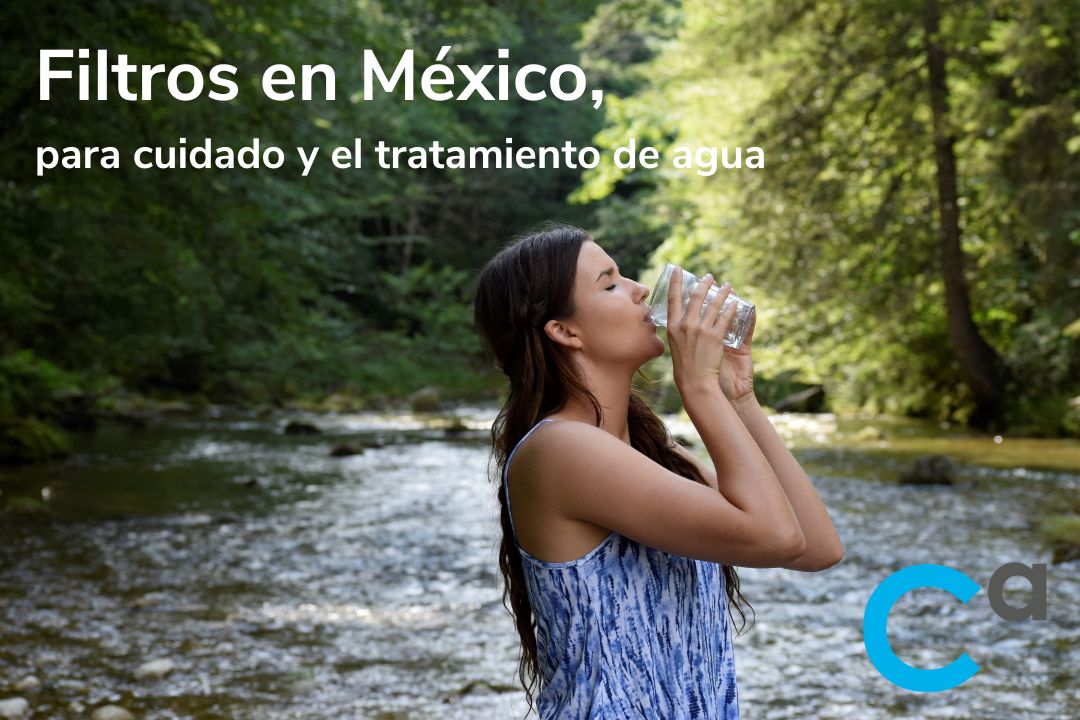
Filters in Mexico for water care and treatment.
Water is an essential resource for life on our planet. The quality of water and its use are key factors for the conservation, maintenance and improvement of human health, agriculture, industry and social development. For our country, which has a large territory and not all of it has the water resource, it is of vital importance to take care of it and give it a proper treatment for its reuse. That is why filters in Mexico are becoming more and more important for water treatment.
Water and the environment are interconnected.
Water is a renewable resource. It can be used for drinking, washing clothes and watering plants. Water also plays an important role in regulating the Earth’s temperature, as it helps control our climate.
Water has existed since the beginning of time and will continue to exist long after we are gone.
Mexico has organized the Agua Limpia Program since 1995 with the support of the federal, state and municipal governments.
The Agua Limpia Program has been organized since 1995 with the support of the federal, state and municipal governments. The program aims to improve water quality in Mexico and is a response to the problem of water scarcity in Mexico.
The country has an annual per capita water resource of 2,169* cubic meters and a deficit of 18 billion cubic meters in average years.
The country has an annual per capita water resource of 2,169* cubic meters and a deficit of 18 billion cubic meters in average years. Water resources are not evenly distributed in Mexico and there are areas with serious problems or without access to potable water.
Average annual precipitation is 1,500 mm, but varies considerably by region. Mean annual precipitation is highest on the Atlantic slope, with 2,600 mm (102 inches) falling on the southeastern coast, gradually decreasing northwestward to 600 mm (24 inches) along the Pacific coast [3] The driest areas are those near the Pacific coast, such as Guadalajara.
By 2030, water scarcity in Latin America will affect more than 130 million people.
Water scarcity is a growing problem. Water scarcity is caused by pollution, climate change and population growth. Water scarcity is a global problem affecting countries in the Middle East and Africa, as well as many parts of Latin America.
By 2030, water scarcity in Latin America will affect more than 130 million people. In Mexico City alone, it is estimated that more than 90% of residents do not have access to clean drinking water because they live above a drained aquifer, a huge subway reservoir filled with groundwater like a natural sponge (1).
In Mexico, more than 50% of the population does not have access to piped drinking water service and 62% of this population is located in rural areas.
In Mexico, more than 50% of the population does not have access to piped drinking water service and 62% of this population is located in rural areas. The problem is more serious in rural areas.
Lack of access to piped drinking water service is a major problem for human development, especially in the poorest communities. It has many consequences such as: high rates of disease transmission due to the use of contaminated water from sources such as rivers and streams; low productivity due to chronic hunger caused by inadequate nutrition; high migration for those who cannot secure their basic needs at home because there are no affordable or safe options available nearby (Porcheron & Wolfson, 2015).
Reuse is one of the best ways to preserve our water resources.
Reusing water is one of the best ways to preserve our water resources. One of the main reasons people don’t reuse water is because they don’t want to deal with the hassle of cleaning it, but this is no longer an excuse when talking about household use. With the technology and devices available today, it has become extremely easy to reuse wastewater and keep your family safe from any harmful bacteria that may be present in what you are using as a source for drinking or cooking. Reused water can also be used for irrigation, which helps save the amount of chemicals used to fertilize plants.
Point-of-use filters in Mexico are an ingenious way to recycle in your home to conserve natural resources.
Point-of-use filters in Mexico are an ingenious way to recycle in your home to conserve natural resources. With the growing problem of plastic bottles ending up in landfills, it is easy to see how these types of filters improve the quality of life for you and the environment from polluting waste. The fact that they also help reduce the amount of plastic bottles that end up in the oceans is an added bonus.
If you want really clean water, one solution is to use water purifiers in the place to use water, it saves many could be exactly what you need. They work by filtering all the impurities out of the water from the municipal mains tap or intakes before it reaches it. This can save a lot of money on bottled water and could even be better for your health (depending on how dirty your local tap supply is).
The filters reduce the use of plastic bottles and promote the circular economy system.
Mexico’s use of water filters reduces the need for plastic bottles and promotes a circular economy system in which materials are reused as much as possible to reduce waste. This is especially important in Mexico, where most households do not have access to safe drinking water.
One example is the water reuse system used by Agricola Dominio del Sur, a Mexican food company that makes tortillas from corn grown on its own land. The corn flour is mixed with filtered wastewater from its plant and sold to customers in its grocery stores, who can then make tortillas at home using their own supply of filtered water.
Water recycling has become an important issue worldwide due to environmental pollution.
Recycling water is a good thing. It is important for the environment to recycle water, because it saves money and helps the Earth. It can also be done at home or in the workplace.
Recycling water can be used for other things besides drinking and watering plants, such as flushing the toilet or washing dishes.
Conclusion
In the future, we hope that water recycling will be a tool to improve the quality of life. We also want everyone to have access to safe drinking water by 2030!
Related articles:
-
Parker PEACH-PURE PCLAS PCLAS Viscous Liquids Filter
Add to quote -
Aquatrol fiberglass tanks for water filters
Add to quote -
Parker PHP series single and multi-cartridge filter holder for liquid filters
Add to quote -
Multi-bag filter holder EB for liquids in the Parker industry
Add to quote -
PEPLYN HA Parker beverage clarification filter PEPLYN HA Parker
Add to quote -
Parker PREPOR NG Microbial and fine particle reduction filter PREPOR NG
Add to quote -
Filter holder with 1 EB single bag for liquids in Parker industry
Add to quote -
Parker PROPOR HC sterilizing filtration cartridge PROPOR HC
Add to quote -
PROPOR BR Parker Bioburden Reduction Filter PROPOR BR Parker
Add to quote -
PROPOR MR Parker mycoplasma removal filter PROPOR MR Parker
Add to quote -
Parker TETPOR AIR Industrial Air Filter
Add to quote -
Parker EH Stainless Steel Single Filter Housing EH
Add to quote